
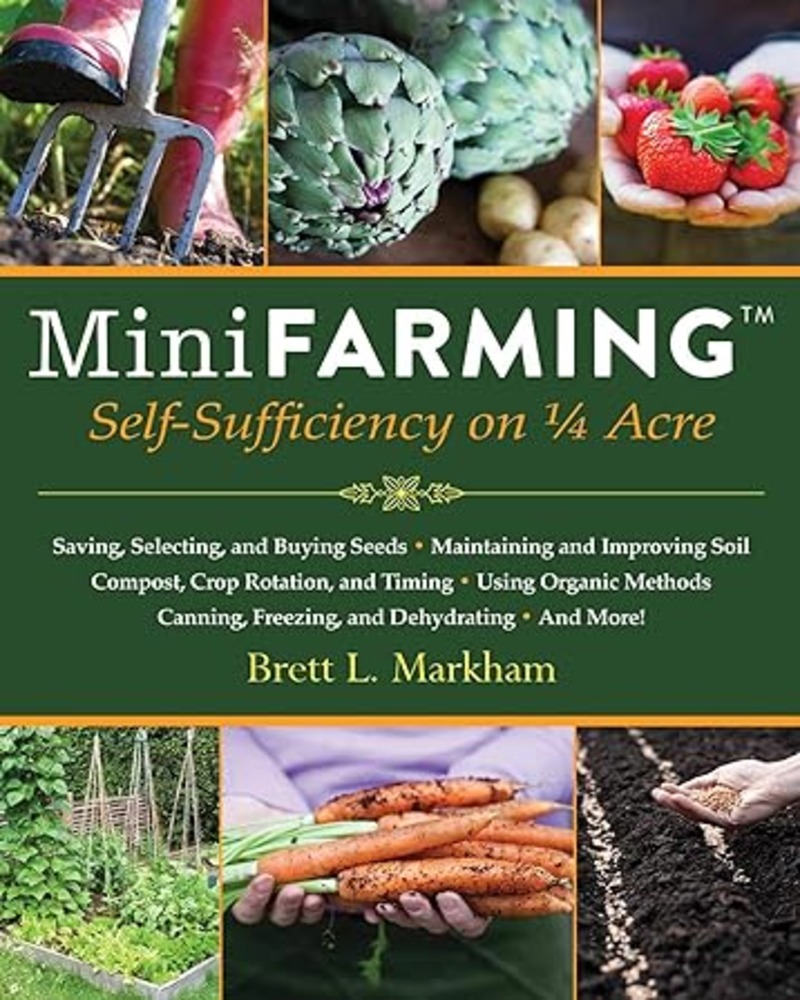




Go back to basics—compost, raising chickens, water and irrigation, dealing with pests, and much more—with this unique, full color bestseller (over 400,000 sold).
Mini Farming describes a holistic approach to small-area farming that will show you how to produce 85 percent of an average family’s food on just a quarter acre—and earn $10,000 in cash annually while spending less than half the time that an ordinary job would require.
Even if you have never been a farmer or a gardener, this book covers everything you need to know to get started:
- Buying and saving seeds
- Starting seedlings
- Establishing raised beds
- Soil fertility practices
- Composting
- Dealing with pest and disease problems
- Crop rotation
- Selling your produce arm planning, and much more.
Because self-sufficiency is the objective, subjects such as raising backyard chickens and home canning are also covered along with numerous methods for keeping costs down and production high. Materials, tools, and techniques are detailed with photographs, tables, diagrams, and illustrations.


My brother is looking to become self sufficient and live off the grid- and I am excited to gift him this, despite the fact he can probably get everything off the internet
BUT if he goes off grid he won’t have the internet! So this book should be helpful for then :)
Highly recommended for new urban farmers!
(Also well constructed and sturdy book which seems relevant for a book that may go outside with you)
(If you're not a math person, don't worry! He doesn't give you math problems to do; he just shows his work when calculating crop yields and stuff. No harm done if you skip those lines here & there.)
Comprehensive explanations on a lot of different, well-organized topics. There's so much free info online I wasn't sure it would be worth it to spring for a resource in book form, but I'm glad I did.
I picked up this book to take my gardening to the next level and broaden my horizons.
In short, I'm very satisfied with the insights and guidance I've gleaned from this book. I'd go so far as to say that while you don't need a background in gardening to benefit from this book, this book is a perfect fit for people in my situation.
Here are the pros and cons from my perspective.
Pros:
- The content of each chapter is very well organized, with concepts building onto one another very neatly.
- The broader subject matter of the chapters takes one through the process of planning, preparing, selecting, timing, managing, etc. most everything one would need to successfully grow a garden.
- This book strikes a good balance between giving you the key information you need for any one aspect of self-sufficient gardening, but not inundating you with too much detail. (In other words, this book threads the needle on delivering a lot of helpful information, while still feeling like an easy read.)
- I've seen other reviews for this book that complain that the author 'rips off' others' ideas and re-packages them for profit. I read quite a bit and have over the years seen serious examples of what these other reviewers are claiming. But, in the case of this book, while the author informs on alternative (and even competing models) for gardening, the author always informs the user on what, in his experience, has or has NOT worked from various models; how he has modified some of those ideas to work in his growing climate; and where he completely parts ways from others' techniques and espouses his own approach (including very clear instruction on how to use his modified or totally unique processes).
- Finally, where possible, the author provides the equivalent of 'modified workouts' for those 'less fit' (MY WORDS, NOT HIS) in their gardening abilities. In other words, the author provides sufficient detail on what might be the most efficient and beneficial approach to say irrigation or composting, but then across the various subjects covered in the book, he provides a less expensive/quicker/initially easier alternative for those lacking the time, resources, space, skills, etc. to fully implement the best possible approach for one aspect or another of gardening. For example, as I'll be looking to expand my garden this next spring, I fully intend to utilize some of the quicker soil prep techniques offered up in this book for use in a pinch while I build up my long-term composting and soil amendment routines.
Cons:
- While some of the chapters really cover all the bases for the targeted subject matter (i.e. plant spacing, soil prep, etc.). Others give you just enough to run with but leave you wanting more. A good example of this would be Chapter 7 ("Time and Yield"). While the author gives a good and broad overview of timing techniques (i.e. succession planting, timed planting, interplanting etc.), for such an important subject matter, I was disappointed by just how short this chapter was. I live in Michigan, with a shorter growing season. I see this topic as critical for people in shorter growing zones like mine, and apart from a quick overview of each of the techniques used to maximize productivity, and a handful of real-world examples of plant groups that work well for things like succession planting (taking into consideration their hardiness in colder climates), this chapter really leaves readers wanting.
- While this book is beautifully illustrated, there's no doubting that the abundance of pretty pictures of garden produce, chickens, tools, etc. serve as fill to make the book feel a bit more substantial in size than it need be. I don't want to over play this point, as A LOT of the illustrations (pictures/graphics/tables) are pertinent to the content of the book (and in any event, some amount of artwork is always nice to have), BUT... I think you could produce this book, still with plenty of beautiful illustrations, and reduce it from its current 227 pages (including the index and notes pages) down to 175 pages.
Stay away from that square foot gardening garbage. It's just hype- almost a cult of followers. If you take all the high maintenance and high cost methods out of square foot gardening and add some sensible and scientific methods, you end up with this method described in mini-farming. I faithfully tried square foot gardening for about 6 years and never accomplished anything until I used this intensive gardening method. Now I grow ALL of the vegetables I eat!
Brett has an abundance of pictures illustrating the process, so it's easy to understand what he's telling you to do. That's what a newbie gardener or mini-farmer needs. Although I haven't finished reading this book, I know, based on the first 35 pages, this one is definitely a keeper!
For a while, now, I've been wanting to start growing at home to save some cash, but time and space are scarce. This book was an eye-opener for me, as one whose thumb is not very green. Granted, it doesn't answer *all* the questions I've had, but combined with other more specialized tomes, this one is a powerhouse for me. If there were a reason to, I'd buy it again.
I was raised on a small farm. Yet I was truly surprised at how much I learned! He covers so much of what I've grown up doing, and still doing for over 50 years. He mentions two books, both classics; both of which I've incorporated into my own growing. He compares these books and suggests what works and doesn't and why.
The book is fast and succinct, with a bounty of information. I marveled at how he got it all in there!! It reads quickly too. Of course he is an engineer, and the book was recommended by a best-friend, also an engineer. :-} This is probably why the information on irrigation, timers and simple watering formulas is easy to learn, painless to recall.
Double-digging is beautifully explained. His charts are straight-forward and quick to comprehend. (not all charts are created equal!). The spacing tip is a precious gem. He presents information without blatant bias. And the material on horse manure is worth a lot of the composting I've done. Thanks to Brett, I've decided not to use it again.
This book arrived the same day as a carefully researched treatise on aquaponics. While aquaponics may be the ultimate food-growing solution, it was a relief to realize my heart is (and always will be) in the dirt. To paraphrase, "fresh air, sunshine, healthy exercise'; Dirt growing has many benefits besides fresh food. I will embark on aquaponics, yet continue my passion of mini-farming.
Two suggestions, more information on transmutable diseases from chickens, especially their manure borne pathogens. (Yes I could research this myself. but now I'm spoiled). And please, please keep writing. I look forward to your next one!
This book has all the information you need to successfully begin producing food for a family of 4 and even discusses how to sell your excess. The author claims that investing in a mini-farm should allow one spouse to stay home because of the cost savings and the potential of selling your own Organic or "Certified Naturally Grown" produce.
I've been living with 2 lifetime farmers for the past 4 months and they have learned several things from this book. I have not had a chance to try everything the author recommends, but Markham does an excellent job showing that anyone can sustain themselves if they have a little land to work with. If you're interested in not depending on the grocery store for your food, this book contains what you need to make that happen.
I don't think you need even 1/4 acre to benefit from all the gardening tips here. Starting out small, trying a few vegetables at a time and learning what will work in your yard is also a way to go. Whether you do that or jump in both feet first, this book will definitely improve both the quantity and quality of the harvest. You will know the kind of time commitment required and how far to take it from there.
This is a very comprehensive book and I encourage people to get this if they are ready to either a) look for a thorough how-to guide or, b) need a refresher course on the basics. I would not call this a Beginners Book, but it can be if you follow instructions carefully. It's got a TON of information in it, from graphs to planting times to temperature basics (for composting). The author provides exhaustive amounts of illustrations, charts, tables and photos to demonstrate in ink, how we do this thing we call Mini Farming. Enjoy!
This book was great! It was very detailed and it answered a lot of the questions I had. This book is good for someone who wants to know what all may be involved in starting your own mini-farm, how much work is needed, equipment recommendations, what you can expect in the beginning as well as how to sustain your mini-farm for years to come.
This book is what I would expect if I went to a expert mini-farmer and asked them to write a book that would give me an idea of what being a mini-farmer was like and what it involved.
I thoroughly enjoyed reading this book. It has large text and thick pages and is well written. Every once in a while the author gets a little deep into facts or figures, but sometimes it helped me understand a particular aspect in greater detail.
I have always wanted to keep chickens and have my own fresh eggs. After reading this book and seeing what was involved, I decided I might not want to get into all that... This book doesn't tell you everything you need to know to raise chickens, but it was enough to get a good idea about how much work it could possibly be. Not saying I'll never try, just know I'm not going to try and tackle starting a mini-farm and raising chickens all in the same year.
Oh, and if you ever wanted to know how to slaughter your own chickens, the author goes into great detail... I don't know what else you would need to know... He even gives you plans for building your own chicken plucker.
After reading this book I don't think I can go out and start a perfect mini-farm, but I do have a better grasp of when and where to start, and what all will be involved. This book is great if you are the type of person who is a planner and wants to lay everything out before you try and tackle a large task.
If you are thinking about planting your own garden for your family or even to sell to make some money on the side, I highly recommend this book.
I liked this book some much I ordered: Maximizing Your Mini Farm: Self-Sufficiency on 1/4 Acre
Maximizing Your Mini Farm: Self-Sufficiency on 1/4 Acre
Update 9 years later (2019): I STILL love this book and continue to gift it to others. I saw some of the prominent reviews which hated the book were from 2017 so I don't know why they are at the top of the list. They also contain inaccurate info. For instance, the one that says every chapter is the author saying where he stole the idea from and where to go read the original content. There are photos of multiple pages of the book in the product description so you can read for yourself and see that is not true. And I would also like to point out, it's gardening! Are there that many original ideas for something humans have done for millennia? So every author that reviewer mentions is also giving readers knowledge obtained from someone else.
Every person I have gifted this book to loves it and learns from it. I've been gardening 10 years now and still learn (or re-learn) now things when I browse through this book. LOVE IT!!!
Original post from November 2012:
I bought this book with slight misgivings simply because all the reviews were so positive and I'm a skeptic. I was thrilled to get the book and learn my fears were baseless. I cannot believe the amount of helpful information in it! It's laid out beautifully, the tips are practical and useful, the photos are gorgeous, and he tells you stuff you didn't even think to think about but totally need to know! I know I'm gushing, but as a newer gardener with a lot to learn who wants to be a GREAT gardener, this book is phenomenal. I'm buying it for my friend for xmas and have recommended it to everyone I know who wants to grow a garden but was always too overwhelmed to do so.
But if a person is looking for good, common sense ideas to benefit his/her gardening technique, this book fills the bill. I've been gardening for close to 50 years. I still love seed catalogs and gardening books. I own quite a few & this one has a lot of good ideas. That's really all I look for in a gardening book: good ideas. I don't need a step-by-step guide or an author to hold my hand as I scheme to make bushels of money, hand over fist, from my truck garden. One has to be realistic, eh?
But I still love new ideas after all these years and this book has quite a few. There may be better books but I'm reviewing this one and I've given it five stars because it's written clearly, has some very pleasant and thoughtful ideas for increasing yields and some decent illustrations to support them.
It could be improved by adding footnotes to back up some of the math he uses but for me, since I'm not thinking of going commercial even though I live in Oklahoma on several acres, I wasn't too concerned with how much money can be made.
I am, however, a believer in sustainable agriculture this book does support that concept. We all need to think in terms of getting our food as close to home as possible, preferably out our back door.
There are probably folks making a good living somewhere off their mini-farm by selling farm to market produce. I think that's terrific. I may sell a watermelon in July or a pumpkin in October myself. If I do, I'll credit Brett Markham's book and give the author and God all the glory. Not because I found a new super-duper technique in the pages of this book but because I firmly believe whether one is a novice gardener or an old dog like me, a new idea or two can always help.
The book is worth the money. Enjoy it. After all, we garden because we like it, don't we?
So far I'm just getting started in "mini-farming" and I've already found the book useful on many accounts. I would highly recommend it to anyone looking for an easy to follow overview with lots of practical insight from an experienced mini-farmer or anyone interested in growing their own food in an efficient, sustainable way.
This is a BIG book. Usually when you get a BIG book like this, the author will try to claim that it is the "comprehensive all inclusive everything you need to know" book to end all books. Brett Markham not only avoids such erroneous claims, he tells you what books he has found useful on various subjects.
Rather than a long list of teeny tiny printed titles in the back, he will tell you right there on the page about starting seeds that he has found Bob's Book of Seed Starting to be useful on the subject. I find that refreshingly honest, and it leaves me a bit more inclined to trust what I read in Markham's book. You are learning what Bob said in his BIG book, and how Brett Markham has applied that knowledge- successfully or otherwise.
I find that very useful.
I highly recommend this book to anyone looking to get the most from your land and your garden.
The only gripes
1) Does not encourage/mention keeping bees which is a great addition, takes little space and having thousands of full time polinators is an added plus if you've got fruit trees or are trying to grow your own seeds.
2) Not enough detail on using inhabited h20 as a heat soak for your frames. Even if you've got stuff no one wants to eat (like carp in a 55 gallon bucket) they'll help cycle your water & provide the chickens some meat.
Adding a chapter on beekeeping and maybe going more in-depth on the fish as a heat soak idea would be nice. Otherwise I'm not sure what more you could ask for. He certainly convinced me to go out and give it a try although I'm not sure I'm going to worry about my own seeds, although it might interesting to experiment.
One caveat is that the author farms in New England. I live in the South, and his ideas about timing of harvests, when to start various vegetables, etc., need major revision here. We are blessed with a longer season and warmer weather. But for that information I can go to my local cooperative extension service or garden supply store. The other caveat is he mostly endorses raised beds. I like raised beds on my clay soil, but if the idea of building raised beds bothers you for some reason, you may want to keep looking.
Mr. Markham has tried the methods out there today -- French Intensive, Biodynamic, Square Foot, etc -- and puts together the most productive hybrid of them while interjecting some rather excellent observations on efficacy, variances due to climate, etc. For instance, the cost of raising one person's yearly ration of wheat would eat up thousands of dollars of possible revenue, cultivated land, and work hours. Instead, spend $50 or so dollars for preground organic wheat and buy a breadmaker... and you'll still come out ahead.
The different approach to the standard how-to technique book is marvelous for all levels of experience. Comprehensive explanations of subjects such as how to journal are excellent for everyone. More research is suggested through extensive footnotes to books, studies, and resources. Excellent comparisons of techniques and careful record keeping are summarized, supporting every point and conclusion.
best one I have read. Markham takes complex topics and explains them in plain english. For example, I now know exactly how to modify soil Ph with specific products in specific measure. I understand how each element influences the equation and why using a variety of soil amendments is advisable. I finally understand the value of Boron in plant physiology with smart ways to apply it. I now "get it" about what bio-char is, how to make it, and why it is important to my soil. I finally understand exactly why deep roto-tilling actually hurts the soil even though it "looks good" in the garden. Thank you Brett!
How to Grow More Vegetables and Fruits: (And Fruits, Nuts, Berries, Grains, and Other Crops) (How to Grow More Vegetables: (And Fruits, Nuts, Berries, Grains,)
, less expensive and resource-hogging (in terms of peat moss, vermiculite, and grids) than
All New Square Foot Gardening
(which is still well worth buying for the beginning gardener; the charts on planting for a continuous three-season harvest alone are probably worth the price of the book). More focused and with more current (though perhaps still debatable) numbers than
One Acre and Security: How to Live Off the Earth Without Ruining It
, and written for an even smaller (and tractor-free) scale than
Successful Small-Scale Farming: An Organic Approach (Down-To-Earth Book)
.
This book contains the simplest and most understandble description of double-digging that I have ever read, and the simplest way of placing seeds at the correct spacing in intensive gardening. It has good discussions of thermophilic composting and of the importance of aging compost; various types of irrigation systems; food requirements per person and practical ways of meeting them (including the economic infeasibility of growing wheat in the home garden); making aerated compost tea with a simple and inexpensive homemade system; the best media for seed starting; an introduction to saving and storing seeds, and references to excellent books that provide more information (such as
Seed to Seed: Seed Saving and Growing Techniques for Vegetable Gardeners
and
Breed Your Own Vegetable Varieties: The Gardener's & Farmer's Guide to Plant Breeding & Seed Saving
); inexpensive ways to extend the growing season; fruit trees, bushes, and vines; raising poultry for eggs and/or meat; organic and certified naturally grown; and maximizing the money you make selling produce. The chapter on preserving the harvest by canning, freezing, and dehydrating (no mention of
Root Cellaring: Natural Cold Storage of Fruits & Vegetables
) is not in-depth and will not take the place of other books on the subject, but serves as a good introduction. The only disappointment to me was that there was no mention of sheet composting (see
Lasagna Gardening: A New Layering System for Bountiful Gardens: No Digging, No Tilling,No Weeding, No Kidding!
); I might suggest building your raised beds in that way rather than by double digging.
If you are trying to move off the grid, grow 100% of your own food, and make your own clothes, this may not be the book for you. If you'd like to raise a lot of your own food in a garden that will fit in the typical suburban yard (the actual number of square feet he suggests cultivating for a family of three is just under 1/20th of an acre), this book is a great place to start.