


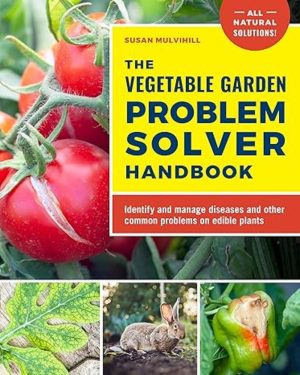
In The Vegetable Garden Pest Handbook, you’ll find the simple, straightforward resources and tools you need to identify common pests of edible gardens and manage them without the use of synthetic chemical pesticides.
Climate change and newly introduced insect pests are changing the world of gardening. Pests that once produced a single generation per year are now producing two or even three, and accidentally imported pest insects have no natural predators to keep them in check. These leaf-munching critters can cause significant damage in short order, reducing your yields and costing you time and money, especially if your garden is out of balance or your plants are stressed and vulnerable.
Whether you’re a new or seasoned gardener, author and garden pro Susan Mulvihill shows you how to handle pest issues by growing healthier plants, properly identifying the culprit, and nurturing the overall ecosystem of the garden. With easy-to-use charts, you’ll learn how to identify common vegetable garden pests based on both the damage they cause and their physical appearance.
DIY pest-control projects, coupled with up-to-date info on the best natural products, physical pest-control tricks, and tips for managing pests with the use of traps and barriers, all lead to a garden where beneficial insects and pollinators are preserved while pest populations are kept in check.
Learn how to:
- Get rid of squash bugs with minimal effort
- Screen out root maggots
- Keep cutworms at bay
- Nurture the good bugs that help control tomato hornworms
- Tackle an infestation of mites, thrips, or whiteflies
- Send cucumber beetles packing
- Limit cabbage worms with a simple, inexpensive trick
- Learn about the best earth-friendly product controls for home vegetable gardeners Identifying and controlling common vegetable garden pests has never been a favorite task of gardeners, but with Susan’s help, positive results are easier than you think!




I've been a master gardener over 22yrs. With all the new invasive species being introduced here by inexperienced hemp growers, this is a great tool to grow food that is safe and delicious.
This is a practical and accessible guide, well arranged and sensibly realistic in its reach and scope. The author is clearly knowledgeable and experienced and that comes through in the text. The introduction does a good job of introducing and explaining some basic terms (what -is- organic gardening, what is integrated pest management, "bug" ID, a solid overview of good cultural practice and how to adapt and integrate it into the reader's particular situation, wildlife and diversity, and how to attract wildlife/birds for a robust and diverse biome. Although it's easy to understand for beginners, there's a lot of information here and even more advanced gardeners will find tips and good advice.
The following chapters include a gallery/bestiary of bugs which include the most common (and a few uncommon) bugs which gardeners in North America are likely to encounter. Profiles include photos of both the bugs (some with multiple photos of different life stages) and what the damage to plants typically looks like. The profiles also include taxonomy info (Latin name) as well as life cycle, range, and controls.
The book's third section is a well organized tutorial guide for different organic pest control treatments and a neat collection of DIY project tutorials. It's photographed clearly and in color throughout. The author has also included a resource/suppliers list, a rogue's gallery of bug-shots, and a cross-referenced index.
Five stars. Well written and useful. This would make an excellent choice for public or school library acquisition, allotment/community garden library, and home use. Although this book is slanted toward readers in North America, there are enough common garden pests here which will be quite familiar to gardeners on other continents.
Disclosure: I received an ARC at no cost from the author/publisher for review purposes.
Thank-you Susan, also for the YouTube Videos
Did anyone else have an over abundance of bugs in their garden this year. I usually have some, but this year it was INSANE!
I did use the soy sauce/oil trap for the earwigs that seemed to be taking over my raised beds this year, And it worked really well!
This is a great resource to identify good and bad bugs and how to attract, repel or kill them! I pulled this thing off my shelf at least a dozen times this summer. The book is great, the information is easy to find. I know I'll be using this book for years to come!
Definitely recommend for your garden resource collection.
Review for Paperback:
We live in the South and keep trying to have a garden each year but end up losing a lot of crops to pests. We like to not use harsh pesticides on our plants so that is one reason why we lose a lot of plants. The Vegetable Garden Pest Handbook is a book that identifies and solves common pest problems on edible plants. The book contains all natural solutions.
The book has a nice thick glossy cover. The inside pages are thick and glossy and filled with full-color photos.
The book is divided into three sections:
1- Introduction to Organic Pest Management in the Vegetable Garden
2- Meet the Bugs
3- Organic Pest Management Products and DIY Pest Controls
I really like that in the section of “Meet the Bugs” that there is a chart with the plants listed and then you can look up the problem you may be having. With the chart, you don’t have to figure out which bug it is but can look up the problem or damage. The rest of the chapter lists the bugs theirselves.
In the back of the book, there is a mugshot gallery of all the bugs with a small photo and name along with the corresponding page number within the book.
⛵⚓Seas the Day⚓⛵
It's not necessarily a reference book or encyclopedia, but it walks you through how to think about and plan for pests.
It's basically a how-to for insect control and management. I'm new to gardening and still working out how to best manage my pests. I like that the author walks the reader thru various methods including garden covers, things you can spray or sprinkle in the garden, and helpful predator bugs.
My favorite part is the section in the back that has mug shots of all the bugs she talks about in the book. I can take it to my garden and match it with the bug I see. I only wish the mug shots were ordered by bug color.
But that’s JustMe. (I received this product in exchange for an honest review, and that is what I have offered here.)
Why I Recommend this book:
1) The methods are natural NOT chemical pesticides. This is important for me and my family.
2) The author divided the book into two easy to understand sections: By “Vegetable” and then by “Pest”.
For example, you can look up the vegetable (ordered alphabetically) and it explains problem/damage appearance and the possible pests. OR if you already know the pest that’s causing the problem, it can be looked up (also alphabetically) and it will show large 3” X3” color photos of the pest. It discusses the life cycle, signs of activity, and how to control it.
3) There are also DIY projects such as cucumber beetle trap and cutworm collars.
4) The author also teaches how to use Neem and insecticide soap.
5) Easy to read font.
My main use for this book was identifying the pests aphids and whiteflies. It really helped me to find alternatives to chemical pesticides. One pearl I learned was not to buy those ladybugs at the store, because they may be non-natives and could impact the local native ladybug population. I will definitely be referring to this book many times in the future. This is a very valuable source for gardeners.
This is an exceptional reference fully deserving 6 stars. It is extensive and well organized while providing lots of pictures. You don’t want to read it, you want to use it. If you’ve seen the pest you’ll likely find a mugshot of it in the Bug Mugshot Gallery beginning on page 194. You find a pest name, picture and a page number with all the information about the rascal and how to manage/treat it. Suppose instead you have damage in the garden but haven’t seen the cause. For example, say you have holes in your squash plant leaves. Beginning on page 36 you’ll find the vegetables tabled in alphabetical order. Squash is on page 55. There you’ll find possible problems and likely villains. Easy peasy. Other major sections are about Organic Pest Controls and DIY Pest Control Projects. Great book.
The handbook makes it easy to identify garden problems because it comes at them from several different directions. The beginning of the book has a table of vegetables, their pests, how to identify the damage from them, and how to solve the problem. Later, each pest gets a two-page spread with photos, life cycle information, a list of natural predators, and control methods. The table of beneficial insects is more compact, but since they don't cause damage or require control, it still has all the information you'll need. The book includes sections on organic controls and DIY pest control projects. Although it's not new to me, I especially appreciate the photographic illustrations of what ladybug larvae look like since an unsuspecting gardener would likely destroy them based on appearance alone.
You don't have to be a master gardener to grow vegetables to feed your family, but for best success, you need to be armed with knowledge about which pests can affect your yield and crop quality. This handbook is a great reference guide to assist all season long.
-- Debbie Lee Wesselmann
The first half of the book is devoted to garden pest identification—every bug can be clearly recognized through many photos and drawings. Each bug’s life cycle is explained, and helpful tips include what the bugs are typically seen on, signs of their activity, natural predators and proper controls to thwart their propagation. Even though I can identify most of these pests, others may welcome such a concise, informative guide. A quick bug mugshot gallery in the back of the book makes pest ID even easier—once you’ve identified what’s ailing your garden through the mug shots, a page number leads you to the more thorough information I mentioned previously. Another way to identify potential problems can be found by simply looking up what vegetable crop you’re dealing with—the author includes a handy table that alphabetically lists plant names (like asparagus, kale, melon, etc), what the problem/damage is and possible culprits. Once that is narrowed down, page numbers again point readers to more specific information/further help.
This is one of the most organized garden handbooks I have ever come across—lots of cross-referencing to make pest ID easy, with all-natural solutions to control them.
If you grow your own vegetables, and you are into organic, it is a must.
The Vegetable Garden Pest Handbook is a very detailed read with lots of pictures and larval stages to help those like me find the problems before they start. And then, if they do start, very practical steps to take. The book breaks down common bugs and pests by plant and gives a bunch of solutions. Which I am so here for.
There are a lot of bugs, so if you don't like that sort of thing, well, just be forewarned. I, however, found it extremely helpful.
As I already stated, there are tons of beautiful pictures and a lot of educational information to aid you through your planting lifecycles. The author provides many natural solutions before heading for the big guns.
I would absolutely recommend this book for gardeners of all expertise and attention levels. May you get many fruitful returns from its use.
*ARC provided by NetGalley in exchange for an honest review.*
I have always been a bio-dynamic gardener and rely on natural growing methods. Although written in America, it can be adapted and used in all countries.
I recall a year when the aphids were really making a feast of my roses. Whilst distressing I gave it a few day and soon the ladybugs, hover fly and birds where having a feast, and whilst a little damage was done, my roses thrived with very little work from me.
This is an excellent book with great information ad would also be fabulous to give to a child with interest in gardening and natural science.
Content well organized. This is an outstanding contribution!