
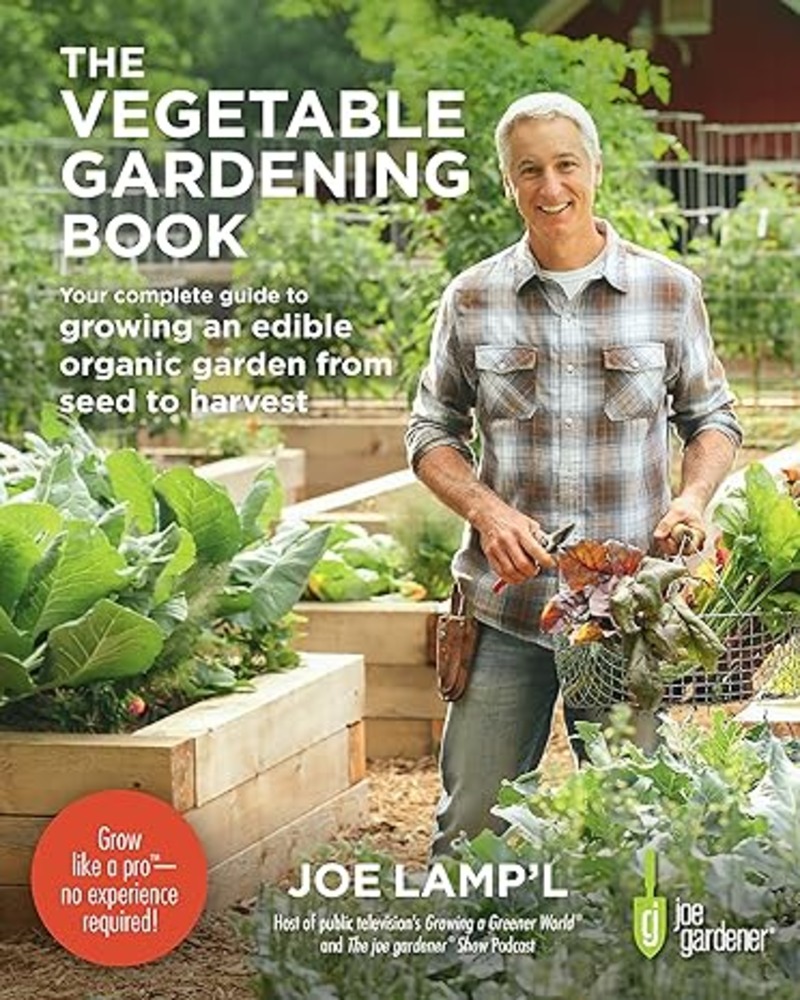




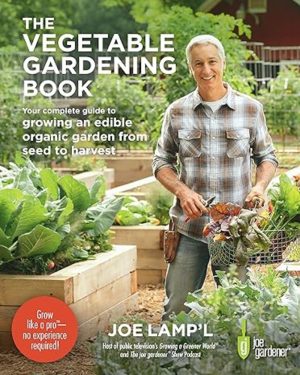
The award-winning television and podcast host Joe Lamp’l is here with insider tips and next-level insight for creating a lush, fruitful, and resilient vegetable garden.
Just when you think you have a secure grip on what it takes to grow a vegetable garden, a pro like Joe comes along to surprise you with a wheelbarrow full of new-to-you information to knock your gardening socks right off. In The Vegetable Gardening Book, Joe distills insight from years interviewing highly experienced growers for public television’s Growing a Greener World and The joe gardener® Show Podcast along with his own extensive, hands-on knowledge of the craft to present practical and useful info on everything from starting seeds and selecting varieties to building the perfect tomato cage, encouraging pollinators, and creating biodiversity-rich soil in a 100% organic food garden. This book is essential reading for anyone interested in growing the best edible garden their backyard (or balcony!) has ever seen.
Inside you’ll find:
- Ideas for designing and laying out your garden for the greatest yields in the smallest amount of space
- A sure-fire plan for reducing maintenance and trimming down the traditional workload of a garden
- Detailed growing profiles of 40 of Joe’s favorite crops
- A handy reference chart with an easy-to-follow crop rotation plan
- Advice and tips for extending the growing season, building raised beds, setting up a potting station, and deciding which garden tools are worth your time and money
- Strategies to grow anywhere and everywhere—from in-ground garden beds and containers to grow bags and raised-bed planters
Among the most trusted, recognizable, and sought-after voices in the gardening world, Joe Lamp’l is here to help you “Grow like a pro – no experience required!™”


I haven’t finished it yet, there’s lots of really good information in there. I’m rusty with my knowledge and gardening skills. It’s a refresher as much as a guide of how to set things up and everything in between.
Definitely recommend for beginners, but also for any gardener looking to find better success during harvest time.
The list of chapters are: All About Soil; Plant Basics; Where to Grow Your Food; Feeding Your Plants; Seeds and Seedlings; Getting the Timing Right; Mulch Matters; Getting the Watering Right; Extending the Season; Insects and Bugs; and Diseases - Managing the Inevitable.
The second half of the book is Growing Guides for his “Fab 40” picks. These are invaluable guides on 40 different vegetables to grow, each 1-4 pages long. There are details about germination time, and the best time to plant (either starting inside or outside). He explains the difference between varieties of each plant and there’s advice about the pests associated with individual plants. Each guide has tips for the best area to plant the crop; mid-season care; and the right way to harvest. I have learned so much. The book also has swoon-worthy photos of different garden setups that will both impress and inspire.
The chapter on bugs is really helpful: it explains which are friends or foes, and has photos to help you recognize what you’re dealing with. There are ideas for organizing your garden so you can create a barrier of decorative plants that the bugs will gravitate towards while hopefully keeping them away from your produce plants.
I garden in Zone 9b, and usually get a handful of nights that hover right around freezing—just low enough where it has killed some plants. I found the chapter on “Extending the Season” to be really helpful, as I can use some of his tips to manage my crops this winter. I particularly loved his idea for using a plastic milk jug as a cloche, or a one-plant greenhouse.
This is a well written, accessible, guide to fruit and vegetable gardening. It's beautifully and clearly photographed throughout. The specific crop guides are useful and not exaggerated or overly complex. The text is clear and specific with good info on troubleshooting and pest control. The author covers seed starting pretty well and gives practical usable advice for getting seeds started, hardening off, transplanting, caring for the plants in the garden, through to harvesting.
Five stars. One of the best gardening books I've reviewed in 2022, maybe the best, definitely top 5. This would be a great pick for public or school library acquisition, gardening group libraries, activity groups, and home use.
Disclosure: I received an ARC at no cost from the author/publisher for review purposes.
I also like the amount of photographs and the engaging writing style by the author. It kept me reading where I may have fallen off with the information overload. Just a really nicely done book on vegetable gardening.
My grandfather had a system and I thought I'd used it well, but I was wrong. My yard was poorly set up. He used 4' lath steaks, tie string, a large coffee can with the bottom cut out, and pushed into the soil one for each plant. He used pre-grown small plants grown at the greenhouse in early spring, and not seeds to get a good start after the last Indiana frost. He never sprayed water on the plant directly but would put a little fertilizer in the bottom of the coffee can and fill the can with water daily. His tomatoes were early and large.
I tried this a few times now that I have my own house, but I lined them up by the back fence and they didn't get much sun, mistake one. Watering was either hit or miss I'd fill the cans, but sometimes the rain would flood that part of the yard. The soil was not great either and I had crops of sorry looking tomatoes and tried to grow new types like plums and others, but no luck. This book helps point out how everything I did had certain problems, it helped with what sun to get, and what kind of drainage to use. I can't wait to try this out next year and see what I can do. I now know a good spot and it will be easier to get water to that area and the sun period will be easier on the plants as well. Great book.
Just getting started was always a sticking point for me, but this book goes into detail about planning your garden from estimating optimal garden size to garden placement. There are also tips about how to estimate the amount of soil, vegetables and other materials you will need.
The book is divided logically by the chapters you will need to progress through your growing season. When do I plant? Do I plan seeds or seedlings? What do I do to keep the plants alive and thriving through the growing season? When do I harvest? How do I replant the following year?
The last section of the book is devoted to specific grow guides for 40 common vegetables and fruits people plant, including tomatoes, leafy greans, bean varieties, herbs, melons and blueberries. I live in Washington and blueberries do well here, and I plan on making them one of my first crops in the spring.
The book is well-written and attractive with full-color photos throughout. I originally got this book as a guide for me, but I plan on buying two as Christmas gifts for my daughter and neighbor who are also "garden-curious." I think they'll love it.
There is soil care, what to compost, watering, mulch, fertilizing and so on. It's so packed full I went through a few times, finding something new each time. I like the veg by veg on each page showing clearly how to grow that one plant.
Highly recommended
The best part of this book is the Grow Guides. Joe gives you the Fab 40 for filling your vegetable garden, from Artichoke to Winter Squash. I like the way he breaks down each plant in the Down and Dirty (preferred climate, Sun, Soil, PH range, Sow seeds, Sowing depth, Days to germination , Notes, Transplant seedlings, Spacing and Days to maturity). For each plant he will give you notes, his favorite varieties, Planting info, mid season care, pests and disease and harvesting. Each plant in the Fab 40 is covered in 3-4 pages. I really like the notes from the garden and Joe's favorite varieties.
I've read this book cover to cover once, and will be reading it multiple times this fall and winter - so I am prepared to start late winter/early spring with my inside seeds.
Highly recommended!!
Joe is a down to earth helpful gardener.
The book is like his TV show exciting.
This book covers so many vegetables and herbs. The photos are excellent and the information is very helpful and interesting. It’s a “go-to” book when you’re looking for specific info and it’s also a book you can sit and read cover to cover!
This book should be read and re-read prior to growing season so that gardeners can be ready for when the seed catalogs arrive at the end of December/January.
-- Debbie Lee Wesselmann
The one thing that comes up with most gardening books for me is also true of this one--and that's that it's largely designed for a different climate than the Mediterranean one I live in here in Southern California. So some of the crops and tips are less relevant for me than they are for people living on the East Coast or Midwest.
That said, it's still a valuable resource and I'm enjoying it.
As someone who wishes I could grow tomatoes, I was hopeful for a piece of advice about hornworms. Even growing from seed, the moths would find the plants and the hornworms would destroy them and the tomatoes. Often the first sign is seeing droppings that look a bit like a rabbit was near your plants! They're a reason I gave up on lovely heirloom, home-grown tomatoes. Unfortunately, the advice was the same I already knew, of manually looking for and removing them (p. 240), or a piece of advice that may or may not be reliable (p. 185). Though Bt is recommended at times, much of the advice when it comes to pests is prevention, such as covering them plants up, or removing things by hand, or hoping for Mother Nature's beneficial insects to take care of the issue for you. I could see this bothering some who want easier answers.
The author is in favor of starting from seed, but I don't think in a snobbish way at all. I think this is a positive thing because it means the book is more thorough than just telling you to go pick up some seedlings. But that's also something you're encouraged to do.
The back of the book covers 40 crops (actually more since herbs are counted as one), and not all of them veggies, in alphabetical order.
The only real critiques I have about the book are stylistic. The sidebars threw me for a loop at times, because they can be a bit disruptive and are distinguishable mainly by a different font being used. I think they could have been placed differently, and perhaps with a colored background to help differentiate them from the rest of the book's content.
Also, the book interior is just lovely, with shiny paper and full-color photos. But the paper is heavy, so it's a bit unwieldy for a paperback. I would have preferred it in hardcover to make it more sturdy.
Those things aside, it's a great book, and I really appreciate how thorough it is, and how much the author knows and hopes to share with others.
―Lisa Steele, founder of Fresh Eggs Daily and author of Gardening with Chickens
Rene' Shepherd Master Gardener from Grass Lake, MI Zone 5b
I have listened to Joe Gardener podcasts for several years, am enrolled in the JG classes online and have accumulated a lot of gardening knowledge. This year I finally got to grow a bona fide garden from seed to lush healthy plants to an actual harvest!! So different from my previous sad attempts at gardening – Joe’s teaching really makes a difference!
Joe’s new book is a compilation of all his gardening knowledge distilled down to the really important stuff to know about gardening in the first 12 chapters and then a section with all the details for 40 different vegetables and fruits (which of course I read first for my favorite vegetables). As I’m reading the first 12 chapters, I’m finding that it is providing a sort of a framework or foundation to which I can pin all the various facts and observations I’ve accumulated, giving my brain a lot of “Aha” moments as I read and a much clearer overall picture of gardening. Aha moment in Chapter 2 “oh, my soil test wasn’t bad – it’s actually quite good!” This is an exceptionally useful book!
This is engagingly written, with clear information pertaining to soil, compost, light, water, location, seasons and more. Then you get to the goodies, the fab 40 vegetables for filling your vegetable garden. Each vegetable with its own, ‘down and dirty’ section that puts the basics into a table and then expands on things like varieties, diseases and care.
If you are already a success in the garden this might be too basic for you.
For me, with my largest tomato harvest this summer consisting of three cherry tomatoes, this I all the stuff I didn’t know I didn’t know.
I am a seasoned gardener, doing Master Gardener's twice ( hard to maintain the hours when you work full time and have children at home) , and I learn something new every year. This book is a great reference guide, so I will be keeping this handy in my gardening shed.
You will learn how to prepare the soil, what to put in it to give plants the best chance to grow, how to care for seeds and seedlings, and what to grow in your soil. You will be instructed on making your own compost pile so your plants can thrive.
You will be shown how to plant vegetables, flowers and fruits in the ground, on a raised bed, or in a portable structure. His maxim is to grow what you will eat and grow it in a respect to nature method.
You will be shown how to look for signs of disease, rot and mildew and how to think like a plant!
This will be an invaluable resource for growing plants in your backyard!